
What's inside
- Best High End Laptop Cooling Pad for Gaming: Pressure and Seal Beat a Deck Full of Small Fans
- Quick Comparison: High End Gaming Cooling Pads Compared
- The Six High End Cooling Pads Reviewed
- Buying Guide: Confirm Your Intakes, Choose Your Size Variant, Prove It on Your Own Laptop
- How We Selected These High End Cooling Pads
- Frequently Asked Questions: High End Gaming Cooling Pads
As an Amazon Associate I earn from qualifying purchases. This post may contain affiliate links at no extra cost to you.
The best high end laptop cooling pad for gaming has changed its shape in the last few years, and the change explains almost everything about which models are worth premium money. The old high end meant a handsome aluminium deck, several mid-sized fans, lighting, and a promise of cooler gaming that in practice delivered a few degrees on a good day. The new high end is dominated by a different idea altogether: a single large, powerful fan in a sealed chamber, a foam gasket that presses against the underside of the laptop, and air forced through the machine’s own intake vents under pressure, rather than merely blown in their general direction. On a gaming laptop whose intakes are on its base, which is most of them, that sealed-pressure design is measurably the stronger parish, and the premium now buys pressure, filtration, and control rather than decoration.
Honesty must govern the whole category, because cooling pads attract inflated claims the way a hot chassis attracts dust. No pad repeals the physics of a thin gaming laptop: the machine’s own fans, heatsinks, and power limits decide its temperatures, and a pad is an assistant, not a transplant. What a good pad genuinely does is feed the intakes cooler air at greater pressure, lift the base off a desk that would otherwise choke it and reflect heat back, and in the best designs filter the air it pushes, so the laptop’s internal fans and fins clog more slowly. The realistic result is lower temperatures under sustained load, quieter internal fans for the same performance, or a little more sustained performance at the same temperature, depending on how the laptop’s own control system chooses to spend the headroom. A buyer expecting a pad to turn a badly cooled laptop into a desktop will be disappointed; a buyer expecting a hard gaming session to run cooler, steadier, and less frantically will be well served by the top rows of this table.
This guide grades the current premium pads on the figures that decide a gaming desk: design type and sealing, fan and airflow parish as the makers publish it, compatibility with the 15 to 18 inch machines gamers actually own, dust filtration, noise at working speeds, height and ergonomic adjustment, and the extras that earn their keep, from powered USB hubs to memory foam seals sized for different chassis. Prices are ranges throughout, and every model named is real and currently sold.
Our Top Picks
Best High End Laptop Cooling Pad for Gaming: Pressure and Seal Beat a Deck Full of Small Fans
Design Types for the Best High End Laptop Cooling Pad for Gaming
Three designs share the premium shelf, and they are not equals. The sealed pressure pad, represented by the Llano and IETS rows of this table, surrounds one large high-speed fan with a foam seal that mates to the laptop’s underside, so the air has nowhere to go but through the intakes. It is the design to buy when thermals are the whole point, and its conditions are honest ones: the seal must fit your chassis size, the laptop’s intakes must be on its base, and at full speed these pads are loud in the way a small vacuum is loud, which for a headset-wearing gamer is a fair trade and for a shared room is not. The open multi-fan deck, the classic Cooler Master and Klim parish, places several fans under a mesh or aluminium surface; it is quieter, more forgiving of any laptop shape, doubles as a comfortable stand, and delivers a gentler improvement that suits long sessions and mixed work and play. The adaptive premium pad, represented by Razer’s entry, adds powered control, a hub, and smart fan behaviour to the open or semi-sealed idea, selling refinement and an ecosystem rather than raw pressure.
Match the design to the machine before the wallet. Check where your laptop actually breathes: most gaming models draw through the base and exhaust at the sides or rear, which is the sealed pad’s home ground, but a model that draws significantly through the keyboard deck or the hinge parish gains less from underside pressure and is better served by a stand that simply lifts and frees it. Check size with the same care, because a seal sized for a 17 inch chassis under a 14 inch laptop is no seal at all, and several of these pads are sold in size variants that must be chosen correctly. Finally, check the power arrangement: the strong pressure pads draw real power and may need their own supply or a dedicated USB connection rather than a lazy port on the laptop, and a pad that dims when the laptop sleeps is a pad mis-plumbed.
Noise, Filtration and Ergonomics for the Best High End Laptop Cooling Pad for Gaming
Noise is the premium category’s honest tax, and it should be budgeted like money. Air moved under pressure makes sound, and the makers’ own figures for the strongest pads at full speed are in the parish of a loud room fan. In practice almost nobody games at full speed: the useful working range, where most of the cooling is won, sits lower and quieter, and a pad with fine, smooth speed control lets you live in that range instead of choosing between silent and screaming. Judge a pad by its control as much as its ceiling — a stepless dial or a well-spaced set of speeds, remembered between sessions, is worth more than a higher maximum you will never use. Headset players can spend noise freely; streamers with a microphone and anyone sharing a room should weight the quieter deck designs heavily, because a pad that gets switched off cools nothing.
Filtration is the premium feature nobody photographs and everybody should want. A gaming laptop’s internal cooling clogs with dust across a year or two, its fans and fin stacks slowly blanketed until temperatures climb and a strip-down clean becomes necessary. A sealed pad with a washable or replaceable filter interposes itself between the room and the intakes, catching much of that dust before the laptop does, and on a hard-played machine that alone can preserve as-new thermals far longer. Ergonomics complete the audit: height adjustment that raises the screen and tilts the keyboard to a sustainable angle, a wrist-friendly front lip, and stability under a heavy 18 inch machine are daily qualities, and a pad that wobbles or slides will be resented long after its temperature figures are forgotten. Lighting, finally, is decoration; enjoy it where it comes, and never let it promote a pad over pressure, filtration, and control.
Setting Up and Proving the Best High End Laptop Cooling Pad for Gaming Works
A premium pad deserves a ten-minute proof rather than a first impression. Before the pad, run your most demanding game or a repeatable heavy load for a fixed period and note the temperatures and, where your tools show them, the frame rate and the laptop fan behaviour, in the same room and at the same settings. Fit the pad carefully: the seal seated evenly against the base with no gap at the corners, the laptop centred, the pad’s power properly supplied, and its filter in place. Repeat the identical load at a moderate pad speed, then at the highest speed you can tolerate, and compare like with like. A pad that earns its premium shows a clear improvement at a tolerable noise level on your machine, not on a reviewer’s different one. If the improvement is absent, the usual causes are a broken seal, intakes that are not where the pad assumes, or a laptop already limited by something else, and each is better discovered in the returns window than rationalised after it.
Keep the parish clean and the comparison honest across the year. Wash or replace the filter on the maker’s schedule, oftener in a dusty room or a house with pets, vacuum the pad’s intake, and keep the laptop’s own vents blown out gently as its maker directs. Do not stack the pad on soft furnishings, where its own intake chokes; a hard desk is part of the system. Re-run your proof after a driver change, a repaste, or a move to a warmer room, and remember that a rise in ambient temperature raises every figure in the chain — the pad fights the room as well as the game, and in a hot summer room its work is worth more, not less.
Quick Comparison: High End Gaming Cooling Pads Compared
| Cooling Pad | Best For | Key Specs | Typical Price Range | Rating |
|---|---|---|---|---|
| Llano V12 parish | Sealed pressure — best high end laptop cooling pad for gaming overall | Large single high-speed fan with foam seal parish as published, dust filter, stepless speed control, sizes for large gaming laptops, RGB on many versions | $110 – $150 | 4.7 / 5 |
| IETS GT600 parish | Sealed pressure — best control parish | Large fan with sealed foam parish as published, fine speed control with display classes, dust filter, size variants for 13 to 18 inch classes | $100 – $140 | 4.6 / 5 |
| IETS GT500 parish | Sealed pressure — best value parish | High-speed fan and seal parish as published, dust filter classes, speed settings, sizes for mainstream gaming laptops | $70 – $100 | 4.5 / 5 |
| Razer Laptop Cooling Pad parish | Adaptive — best smart parish | Smart fan control parish as published, sealed foam classes for common sizes, powered USB hub parish, Chroma lighting, premium build | $130 – $170 | 4.4 / 5 |
| Klim Ultimate parish | Open deck — best quiet parish | Multi-fan deck parish as published, large centre fan classes, height adjustment, sizes for large laptops, lighting classes | $70 – $100 | 4.3 / 5 |
| Cooler Master NotePal X3 parish | Open deck — best classic parish | Single large fan deck as published, speed control, height adjustment classes, mesh surface, mainstream size parish | $45 – $70 | 4.2 / 5 |

llano V12 Gaming Laptop Cooling Pad Laptop Cooler Laptop Cooling Fan Stand | 5.5 Inch Turbofan, Airtight Pressure Chamber, for 15.6-19in Laptop, Adjustable Speed, Dustproof, 3-Port USB Hub, Black (RGB)
As an Amazon Associate we earn from qualifying purchases. Product prices and availability are accurate as of the date/time indicated.

Razer Laptop Cooling Pad Adaptive Smart, Intelligent Fan Control | Airtight Pressure Chamber, Fits Most Laptops & Macbooks 14" to 18", Preset & Custom Fan Curves, 3 Port USB Type A, Chroma RGB
As an Amazon Associate we earn from qualifying purchases. Product prices and availability are accurate as of the date/time indicated.
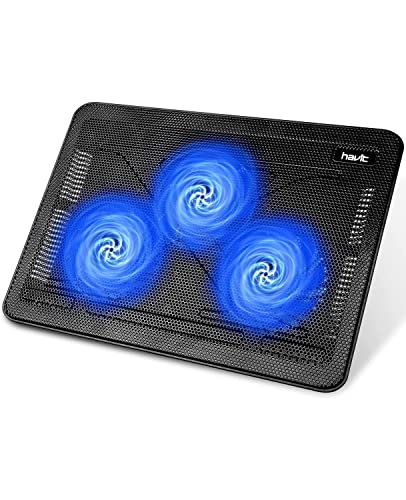
havit HV-F2056 Laptop Cooling Pad for 15.6-17 Inch Laptops, Black | Three quiet USB-powered fans circulate air below the laptop, two height settings improve viewing and typing comfort
As an Amazon Associate we earn from qualifying purchases. Product prices and availability are accurate as of the date/time indicated.
Prices shown are approximate and for reference only. Prices change often, so please check the current price on Amazon before you buy.
Ratings are editorial assessments based on makers’ published fan, size and feature specifications and value at typical prices. Temperature improvements vary substantially by laptop model, room temperature and load; no pad’s figure from another machine transfers to yours.
The Six High End Cooling Pads Reviewed
1. Llano V12 Parish — Best Overall
Llano’s V12 is the sealed-pressure idea in its most complete retail form: strong fan, proper foam seal, filtration, and smooth control in sizes that fit real gaming laptops. For the player whose priority is thermals, the audit ends in this row.
2. IETS GT600 Parish — Best Control
The GT600 refines the same doctrine with particularly fine speed management and a clear readout, letting the player live at exactly the noise they accept. As the control parish, it shares the head of this table.
3. IETS GT500 Parish — Best Sealed Value
The GT500 brings genuine pressure-pad cooling to a markedly lower price, accepting plainer trim for the same essential physics. As the value parish, it earns its row and is the thinking player’s bargain.
4. Razer Parish — Best Smart Pad
Razer’s pad sells intelligence and integration: adaptive fan behaviour, a powered hub, and ecosystem polish, at the category’s premium. As the smart parish, it holds its row for the desk that values refinement beside cooling.
5. Klim Parish — Best Quiet Deck
Klim’s large multi-fan deck cools gently and quietly while serving as a full ergonomic stand for a big machine. As the quiet parish, it holds its place for shared rooms and long sessions.
6. Cooler Master Parish — Best Classic
The NotePal line is the open deck’s elder statesman: simple, adjustable, and honestly priced below the sealed parish. As the classic parish, it completes the table for the player who wants lift and airflow without pressure or volume.
Buying Guide: Confirm Your Intakes, Choose Your Size Variant, Prove It on Your Own Laptop
Step One: Write Your Machine and Your Room
Record the laptop’s exact size class and weight, where its intakes and exhausts are, which you can confirm from its maker’s documents or by inspecting the base and sides, and the temperatures and fan behaviour that trouble you now, measured in your most demanding game. Record the room with equal honesty: shared or solo, headset or speakers or microphone, desk space for a large pad, and the ambient heat of a summer evening. This page decides the design before the brand — sealed pressure for the solo headset player with base intakes, a quiet deck for the shared room, the smart pad for the integrated desk — and it names the size variant you must order, which in this category is a specification, not a detail.
Step Two: Audit Seal, Filtration, Control and Power
For each finalist, audit in order: the seal or deck’s stated size range against your chassis, the filtration and how its filter is cleaned or replaced, the speed control’s fineness and whether the setting is remembered, the noise figures the maker publishes at working speeds rather than only the maximum, the power supply arrangement and any hub’s usefulness to your desk, and the height adjustment’s stability under your machine’s weight. Compose the total price whole, including any size-specific variant or spare filters. Refuse a pad whose size parish excludes your laptop or whose seal cannot mate with its base; in the pressure parish, fit is function, and a near fit is a non-fit wearing a premium price.
Step Three: Prove It, Then Keep the Filter Round
Run the before-and-after proof described in this guide within the returns window, identical game, settings, room and duration, at the pad speeds you can actually live with, and keep the pad only if your own machine shows a clear gain at tolerable noise. Then keep the round: filter washed or replaced on schedule, pad intake vacuumed, laptop vents maintained as its maker directs, the seal inspected for compression or tearing at the season’s turn, and the proof re-run when the room or the machine changes. A premium pad kept this way protects its premium for years, partly by cooling and partly by keeping the laptop’s own cooling clean, which is the quiet half of its value.
How We Selected These High End Cooling Pads
We included only real, named, currently sold cooling pads whose makers publish fan, size, and feature specifications, spanning sealed-pressure, adaptive, and open-deck designs at the premium end of the market. Prices are typical retail ranges. Ratings weight demonstrated design effectiveness first, then filtration, control, noise at working speeds, size honesty, and value, with no credit given for temperature claims transferred from other machines.
Frequently Asked Questions: High End Gaming Cooling Pads
How much cooler will a premium cooling pad actually make my gaming laptop?
By an amount that depends on your machine more than on the pad, which is why this guide insists on your own before-and-after proof. On a laptop with base intakes and a good seal, the pressure designs in this table are the strongest parish the category offers, and players typically see a worthwhile reduction under sustained load, spent by the laptop as lower temperatures, quieter internal fans, or steadier performance. On a machine whose intakes are elsewhere, or one already limited by its power settings rather than its temperatures, the same pad may do very little. Treat any specific degree figure attached to a different laptop as marketing, set the pad up carefully, measure your own result at a noise level you accept, and let that measurement, inside the returns window, make the decision.
Are sealed pressure pads too loud for normal use?
At full speed, they are loud by any standard, and their makers’ own figures say so. At the moderate speeds where most of the benefit lives, they settle into the parish of a purposeful fan, which a headset erases and a quiet room notices. The practical question is your setting: a solo player with a headset can spend noise for thermals without a thought, a streamer must keep the microphone’s parish clean, and a shared room argues for the deck designs or for running a pressure pad low and accepting a smaller gain. Fine speed control is therefore a headline feature in this guide’s audit, because the pad you can tune is the pad you will leave on, and a pad switched off for its noise cools nothing at all.
Will a cooling pad help a laptop that thermal throttles in games?
It can, where heat is truly the limit. If the processor or graphics hardware is reducing its speed because it has reached its temperature ceiling, cooler, pressurised intake air and a lifted base can restore some of that lost headroom, and the proof in step three will show it as steadier frame rates in the same scene. But throttling has other masters: a power limit set by the maker, a silent or balanced performance mode, dust already blanketing the internal fins, or ageing thermal paste are all beyond a pad’s reach, and each has its own remedy in settings, cleaning, or service. Diagnose before you spend — if temperatures are high and fans are frantic, the pad is aimed at the right parish; if temperatures are moderate while performance dips, look elsewhere first.
What size cooling pad do I need for a 17 or 18 inch gaming laptop?
The size variant the maker lists for your class, verified against your chassis’s actual dimensions rather than its screen diagonal alone, because gaming laptops of the same screen size differ in depth and in where their feet and intakes sit. For a sealed pad the seal must land on the flat of the base around the intakes with the laptop’s feet accommodated as the maker intends; too small a variant breaks the seal, too large leaves the machine swimming. Measure the base, compare it with the pad’s published dimensions and its seal’s parish, and choose the variant whose stated range contains your machine comfortably. For an open deck, the requirement relaxes to a stable, fully supported footprint with the intakes over the fan parish — but stability under a heavy 18 inch machine should still be confirmed, not assumed.
Related guides
- How to Choose Shredder for Office Workers: Fellowes, Aurora, Bonsaii, and Dahle Compared for a Security Level Read as a Document, a Duty Cycle That Survives Friday, and Fingers and Aerosols Kept Out of Its Parish Entirely
- Best Cheap NAS Hard Drive Upgrade for Backup in 2026: How to Pick an Affordable NAS Drive That Keeps Your Backups Safe
- Best Portable Printer vs Home Printer for Office Workers: 6 Best Portable Printer vs Home Printer for Office Workers Picks in 2026
- Best NAS Gift for New Year in 2026: 7 NAS Gifts That Offer Easy Storage, Fast Sharing, and Reliable Performance for a Fresh Start in the New Year
More from Amazon
Programs that pair well with the guide above. Offers and eligibility are set by Amazon and may change.
Free shipping on eligible items, Prime Video and more. Eligible new members can start with a free trial.
Start a Prime free trialAd-free music streaming. Eligible new subscribers can start with a free trial.
Try Music Unlimited freeA Prime membership for ages 18-24 with a trial period. Eligibility is set by Amazon.
See Prime for Young AdultsAudiobooks and podcasts to listen to on the go. Eligible new members can start with a free trial.
Try Audible freeAs an Amazon Associate we earn from qualifying purchases.

Write Your Review
No reviews yet. Be the first to share your experience!