
What's inside
- What Makes the Best Budget Surge Protector for Router
- Quick Comparison: Budget Surge Protectors for Routers Compared
- The Six Budget Surge Protectors Reviewed
- Buying Guide: Protecting the Modem and Router Properly
- How We Selected These Budget Surge Protectors for Routers
- Frequently Asked Questions About Surge Protectors for Routers
As an Amazon Associate I earn from qualifying purchases. This post may contain affiliate links at no extra cost to you.
The best budget surge protector for router is a small purchase standing guard over the two boxes your whole household’s connection depends on — and it is bought, in this guide, by a stricter doctrine than the power strip it replaces. The modem and router are the network’s heart and its most surge-exposed parish: they sit powered around the clock, they are connected not only to the wall but to the cable line and sometimes the phone line that enter the house from the street’s own wiring, and a surge does not care which door it uses. The budget parish is full of strips wearing the words surge protection over a component worth pennies, so the floor is set before the table and enforced in every row: the protector must carry a genuine safety listing for surge duty — the UL 1449 parish in North America and its equivalents elsewhere — a published joule rating in the honest hundreds and upward, a clamping voltage in the low parish the standard allows, and a protected indicator light that confesses when its sacrifice is spent. Everything here is ordinary, lawful household electrical equipment, installed by its maker’s instructions; the guide’s standing cautions apply throughout — no daisy-chaining of strips, no protector under a rug or in the damp, the space heater never on any strip, and the whole arrangement replaced when its light says so, because a surge protector is a consumable shield and not a permanent fixture.
Read the joule as the budget it is, because the metaphor is exact. The rating counts the energy the protector’s components can absorb across their service — spent a little by the grid’s ordinary small disturbances, spent wholesale by the one large event the purchase exists for — and when the budget is exhausted the outlets commonly keep working while the protection does not, which is why the indicator light is graded in this guide as a first-class feature rather than a decoration: it is the only clerk who reports the account’s state. The router’s parish sharpens the arithmetic. The network boxes sip power, so the protector’s load parish is trivial; but they are also the devices the household can least afford to lose in the storm’s parish — the connection itself, the work-from-home morning after — and they commonly share their protector with the network’s wider court: the mesh satellite, the switch, the NAS, the smart-home hub. Size the protector for that court, with the outlets and the spacing their wall adapters demand, and read the clamping voltage beside the joules: the lower figure lets less of the surge through to the equipment, and the parish’s honest budget rows publish figures in the 330-to-500-volt range under the standard’s own test. And then — the paragraph the category’s marketing hopes you skip — walk the other doors. The cable modem’s coax line and the DSL parish’s phone line enter from outside the house’s electrical parish entirely, and a protector whose coax or telephone pass-through guards them, connected as its maker directs, closes the network’s back doors for a few dollars of the same purchase. The table includes that parish in its grading, and the buying guide makes it a worksheet line.
Placement and honesty close the introduction. The protector lives at the wall outlet the network parish calls home — the modem’s shelf, the hall cabinet, the office’s corner — on a cord long enough to reach without strain and short enough not to become the room’s tripwire, its outlets’ spacing matched to the adapters’ bulk so that no port is wasted behind a wall-wart’s shoulder. It is not a UPS, and the guide states the distinction the storm’s victims learn: the protector absorbs the spike; it does not carry the router through the outage, which is the battery parish’s separate office, bought separately where the household’s connection must not blink. Nor is any protector in this table a lightning guarantee: the direct strike’s energy exceeds the whole category, and the honest makers say so in their own fine print, which this guide respects by teaching the layered doctrine — the protector for the grid’s ordinary violence, the storm’s big events answered by the household’s insurance and the parish’s humility. Within that honesty, the budget rows below are genuinely good instruments: listed, rated, indicating, and priced so that the network’s heart need never again be plugged straight into the wall by a household that has read this far.
Our Top Picks
 Amazon Basics UPS Battery Backup & Surge ProtectorStandby10.7 x 6.1 x 3.14 inches6.54 poundsCheck on Amazon
What Makes the Best Budget Surge Protector for Router
The Specification Floor: Listing, Joules, Clamping
Three figures decide admission to this table, and the shopper can audit any candidate against them in the shop’s aisle. The listing first: the surge standard’s mark from a recognised laboratory — UL 1449 in the North American parish — which separates the protector from the power strip with aspirations, since the strip’s own listing covers its wiring and not its protection. The joules second: the parish’s floor for the network’s station is set here in the high hundreds, with the table’s leaders in the thousands, remembering the budget metaphor — the figure is the shield’s whole substance, spent across its life — and the router’s court, being the household’s critical parish, argues for the generous end of the budget shelf rather than its floor. The clamping voltage third: the lower the published figure, the less of the event reaches the modem, with the honest rows publishing under the standard’s test and the parish’s best in the low hundreds of volts. A candidate missing any of the three — unlisted, unrated, or silent on clamping — is not a budget protector but a strip in costume, and the guide excludes it however bright its packaging. The connected-equipment warranty that some makers attach is read as a confidence signal rather than a specification: its terms are the maker’s, its claims process is paperwork, and it never substitutes for the three figures.
The Other Doors: Coax, Telephone, and Ethernet
The network’s surge parish enters by wire, and not only by the power wire. The cable modem’s coax arrives from the street’s plant; the DSL line is the telephone parish’s copper; both have carried the storm’s energy into more modems than the wall outlet ever has, and the protectors built for the network station answer with pass-through ports for exactly those lines — the coax pair, the telephone pair — wired in the maker’s order between the wall and the modem. The audit’s cautions are the makers’ own: the coax pass-through must be rated for the parish, since a poor one taxes the signal it guards, and the satellite and antenna lines follow the same doctrine where the household’s television parish shares the cabinet. Ethernet’s parish is the subtler one: within the house, switch to router, the runs are the home’s own and their surge parish is small; the run that enters from outside — the outbuilding’s line, the gate’s camera — is another matter, and its guard is the dedicated parish this budget guide notes without tabling. The worksheet therefore lists every wire that touches the modem and router, from every direction, and the protector is chosen to stand in each path it can — the power certainly, the street’s lines where the model offers — because a shield with an open door is a decoration with a rating.
Form for the Network Shelf: Spacing, Cord, and the Light
The network station’s physical parish grades the table’s rows as surely as their figures. The outlets’ spacing is the first audit: the modem’s and router’s adapters are wall-warts of the parish’s broadest shoulders, and the protector whose outlets are spaced, rotated, or arranged along its edges houses the whole court where the tight row houses half of it and exiles the rest to a second strip — which the no-daisy-chain doctrine forbids as the answer. The cord’s length is bought to the shelf’s honest distance from the wall, its gauge the maker’s listing entire. The indicator lights are read at the purchase: the protected light, whose death is the replacement order, and the grounded or wiring-fault light where offered, which audits the wall outlet itself — the ungrounded parish being a real discovery in older houses, and one the protector cannot fix, only report, the electrician being that worksheet’s next line. The low-profile and right-angle plugs serve the furniture’s parish, the flat plug behind the cabinet being the difference between the cabinet against the wall and the cabinet at its embarrassed angle. Small things, all of them, and exactly the things a protector is lived with for its five years — which is why a guide for the budget parish, whose readers keep their purchases, grades them in the open.
Quick Comparison: Budget Surge Protectors for Routers Compared
| Surge Protector Model | Form / Best For | Key Specs | Typical Price Range | Rating |
|---|---|---|---|---|
| APC SurgeArrest P11VT3 class | Network station — best budget surge protector for router overall | 11 outlets class, coax and telephone pass-through parish, high joule rating class as published | $30 – $45 | 4.7 / 5 |
| Tripp Lite Isobar 6 | Metal premium — best build and filtering | 6 outlets, metal case, isolated filter banks, high joule class as published | $45 – $65 | 4.6 / 5 |
| Belkin 12-Outlet Surge Protector (BE112230 class) | Spaced outlets — best for the whole network court | 12 outlets with sliding covers parish, coax parish in class, long cord options as published | $25 – $40 | 4.5 / 5 |
| CyberPower P606W / wall-tap class | Wall tap — best minimal shelf answer | 6 outlets on the wall tap parish, protected and grounded indicators as published | $15 – $25 | 4.4 / 5 |
| Amazon Basics 6-Outlet Surge Protector | Honest minimum — best rock-bottom budget | 6 outlets, published joule parish in the hundreds, protected indicator as published | $10 – $18 | 4.2 / 5 |
| Monoprice 12-Outlet Surge Protector class | Value bank — best joules per dollar | 12 outlets, high joule class for the price parish, coax parish in class as published | $25 – $40 | 4.4 / 5 |
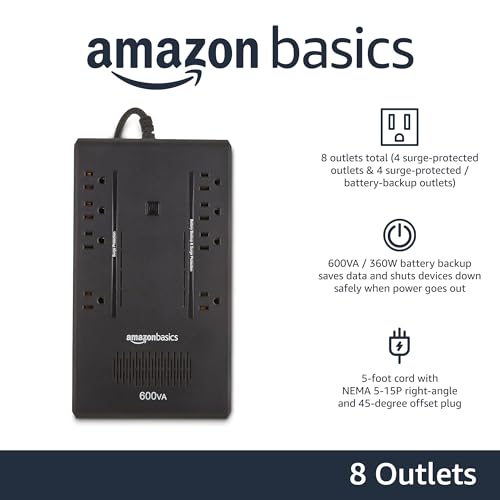
Amazon Basics UPS Battery Backup & Surge Protector, 600VA/360W, 8 Outlets, Standby Uninterruptible Power Supply, Power Outage Protection, Compact Design, Black


As an Amazon Associate we earn from qualifying purchases. Product prices and availability are accurate as of the date/time indicated.

Eaton Tripp Lite BC350 350VA Small UPS 210W Battery Backup Surge Protector | 6 Outlets, Replaceable Battery, Home & Office, 5ft Extension Cord
As an Amazon Associate we earn from qualifying purchases. Product prices and availability are accurate as of the date/time indicated.

CERRXIAN Ethernet Surge Protector 1000Mbps DIN Rail Network Surge Protector LAN Network CAT5/CAT6 Thunder Arrestor for Network Devices, Routers, and Switches Imax 10Ka (36mm DIN-Rail mounting)
As an Amazon Associate we earn from qualifying purchases. Product prices and availability are accurate as of the date/time indicated.
Ratings are editorial assessments for router and modem duty, based on the makers’ published joule ratings, clamping voltages, safety listings, line-protection and indicator features, and value at typical prices. Prices are typical retail ranges. A surge protector’s joule capacity is consumed by events over its life; replace the unit when its protected indicator goes out, and follow the maker’s installation instructions and your local electrical rules.
The Six Budget Surge Protectors Reviewed
1. APC SurgeArrest P11VT3 Class – Best for the Network Station
APC’s network parish is the table’s leader because it was drawn for exactly this station: a bank of outlets sized for the court’s adapters, the coax and telephone pass-throughs standing in the street’s lines, a joule figure in the generous parish, and the indicators reporting protection and wiring in the open — from the maker whose other parish is the UPS the same shelf may add next season. For the modem and router’s home corner, it is the recommendation entire: every door this guide teaches, guarded in one listed body at a budget figure.
2. Tripp Lite Isobar 6 – Best Build
The Isobar is the premium parish’s argument at a still-modest figure: a metal case that will outlive its own components’ parish, isolated filter banks that quiet the line’s noise between the network’s neighbours, and a joule and clamping specification from the serious end of the parish. Its six outlets are its doctrine — the critical few, protected superlatively — which suits the modem, router, and their nearest court exactly. For the buyer who keeps equipment for a decade and audits specifications for pleasure, it is the connoisseur’s row, graded with the respect its build has earned across the parish’s long memory.
3. Belkin 12-Outlet Class – Best for the Whole Court
Belkin’s long bank is the network shelf’s landlord: a dozen outlets with the spacing and the sliding covers the adapter court demands, cord lengths that reach the honest shelf, and in its class the coax parish for the modem’s other door. Its figures sit in the parish’s solid middle, its name is the mainstream’s own. For the station that has grown — mesh, switch, NAS, hub, the television’s corner besides — it is the one-body answer that keeps the daisy chain unbuilt, which is a safety outcome and not merely a tidy one.
4. CyberPower Wall-Tap Class – Best Minimal Answer
The wall-tap parish removes the cord from the geography: the protector seated on the outlet itself, the modem’s shelf directly served, the indicators in view, at the budget’s lower figure. Its parish is the small station — modem, router, one satellite — in the hall cabinet where a corded bank would sprawl. Its audit is the outlet’s own: the tap wants a sound, grounded socket and the furniture’s clearance for its body. Within that parish it is the elegant minimum, graded as the shelf’s neatest sufficient answer.
5. Amazon Basics 6-Outlet – The Honest Minimum
The house brand’s strip is included under the guide’s floor doctrine and passes it: a published joule figure in the honest hundreds, a protected indicator, a listing — the specification’s bones entire, at the shelf’s lowest figure. Its spacing is the tight parish’s and its features are its price’s. For the single router on the small shelf, bought knowingly against the floor’s three figures, it is a legitimate purchase; for the network’s whole court, the guide directs the reader up the table with the worksheet’s outlet count in hand. Its rating is the minimum’s, honestly labelled, which is more than the costume parish below the floor can say.
6. Monoprice 12-Outlet Class – Best Joules per Dollar
Monoprice’s bank is the arithmetic parish’s entry: a high joule figure and a dozen outlets at a figure the named parish reaches with six, from the value house whose cables this site’s readers already keep. Its finish and its warranty parish are its price’s, stated plainly. For the growing station on the watched budget — the NAS arriving, the mesh expanding — it is the value recommendation, bought with the indicator’s doctrine understood and the replacement’s year pencilled on the worksheet at the purchase, as the consumable doctrine requires of every row and this one most cheerfully.
Buying Guide: Protecting the Modem and Router Properly
Step One: Count the Court and Walk the Wires
The worksheet opens with the census: every device at the network station that draws from the wall — modem, router, satellite, switch, NAS, hub, the shelf’s lamp excluded by the doctrine that protection is for the parish that needs it — counted, their adapters’ shoulders imagined in a row, and the total carried to the table as the outlet floor. Then the wires are walked in both directions: the power from the wall; the coax or telephone line from the street’s entry to the modem, whose route decides whether the protector’s pass-through can stand in it; the Ethernet parish noted where any run leaves the house. The wall outlet itself is audited — grounded, sound, its position against the shelf’s geography — since the protector reports the parish it finds and the ungrounded discovery is the electrician’s line, not the shopper’s. Three counts and a walk: the purchase that follows fits the station that exists, which is the only station there is.
Step Two: Install by the Maker’s Order
The protector goes to the wall first and alone — no strip behind it, no chain beyond it — its cord routed unstrained and uncovered, its plug’s parish seated fully. The street’s lines are passed through in the maker’s order where the model offers: wall to protector, protector to modem, the signal checked after, since the modem’s own lights report the coax’s health in their parish language. The court is plugged by the spacing’s logic, the broad adapters at the spaced outlets, the whole court’s load totalled in passing — the network shelf’s draw being modest, the audit is a formality the guide keeps for the habit’s sake. The indicators are read and recorded: protected lit, grounded lit, the worksheet noting the date, because the consumable’s clock starts at the installation and its replacement will be ordered by the light and the calendar together. The router’s parish is then proven in service — the connection’s speed and stability across the first day — since a protector that taxes the line it guards has failed its commissioning and returns inside its window.
Step Three: The Consumable’s Calendar
Keep the protector as the maintained shield it is. The indicator is glanced at on the month’s turn — the same round as the desiccant’s and the filter’s of the organised house — and its death is acted on in the week, not the season: the replacement ordered, the old unit retired entire, since an unprotected-reporting protector is worse than a plain strip in the one way that matters, the confidence it lends. The calendar carries the parish’s other rule: in the storm-prone house and the old-grid parish, the protector is replaced on a rhythm of years even with its light alive, because the joule budget is spent by events no one logged and the light reports the components’ continuity, not their remaining substance to the last joule. The storm’s own doctrine closes the guide: when the big weather is overhead, the household that can unplug the network parish does so, protector and all, since the layered honesty’s final layer is the air gap; and the household that cannot — the connection being the work’s lifeline — accepts the protector’s parish as its shield and the maker’s warranty as its paperwork, with the humility the introduction taught. So chosen, installed, and kept, the best budget surge protector for a router guards the household’s connection for the price of a takeaway, year after year — the least dramatic and most repaid purchase on the network shelf.
How We Selected These Budget Surge Protectors for Routers
We included only real, named, currently sold surge protectors that publish a joule rating and clamping voltage and carry a recognised surge safety listing, spanning the network-station, metal premium, high-outlet, wall-tap, and minimum parishes. No unit is represented as protecting against a direct lightning strike, and line-protection features are described as their makers publish them. Prices are ranges for the protector only; a UPS for outage ride-through is a separate purchase, as the guide explains.
Frequently Asked Questions About Surge Protectors for Routers
How many joules do I need for a modem and router?
More than the network’s modest draw suggests, because the joules are not feeding the router — they are the shield’s substance, spent absorbing the grid’s events across the protector’s whole life. This guide’s floor for the network station sits in the high hundreds, and its recommendation for the household’s critical parish is the generous parish in the low thousands, which the budget shelf reaches without leaving the budget: the table’s leaders live there at takeaway prices. The reasoning is the budget metaphor’s: the small disturbances spend the account steadily, the large event spends it at once, and the station that must still be protected in year four needs the account sized for four years of weather. Pair the figure with the low clamping voltage the audit teaches and the indicator that reports the account’s state, and the specification is complete. The router’s own appetite in watts is, by contrast, a non-question — every row of the table feeds the whole network court without breathing hard — which is why this category is bought on protection figures and outlet counts, and never on load.
Can a surge come through the cable or phone line to my modem?
Yes — it is the network parish’s classic back door, and the casualties are modems whose power cords were protected while their signal lines stood open to the street’s wiring. The coax plant and the telephone copper run from pole to pole through the same weather as the power lines, and the energy they collect arrives at the modem’s signal port, which no power strip guards. The protectors built for the network station answer with the pass-through parish this guide grades: the line routed through the protector’s coax or telephone ports, in the maker’s order, before it reaches the modem, with the signal’s health checked after installation as the commissioning directs. The satellite and antenna lines follow the same doctrine. Ethernet within the house is a lesser parish — its runs are the home’s own — save where a line enters from an outbuilding or the gate, which wants its own guard. Walk every wire that touches the modem, as the worksheet directs; the surge will.
What is the difference between a surge protector and a power strip?
Substance and certification: the protector contains components whose whole office is to absorb the surge’s energy and clamp its voltage, tested and listed under the surge standard; the strip is a row of outlets in a housing, listed for its wiring, containing nothing that answers a surge at all. The confusion is the marketplace’s, cultivated by the costume parish — strips wearing surge language over a token component and no listing — and the audit that cuts through it is the guide’s floor: the surge listing’s mark, a published joule rating of substance, a published clamping voltage, and the protected indicator. A device offering all four is a protector whatever its price; a device missing them is a strip whatever its box declares. The router parish deserves the protector by the argument of the whole guide — the connection’s centrality, the lines from the street, the around-the-clock exposure — and the budget at which the real article sells has retired the last excuse for the costume. Read the figures, not the adjectives; the standard’s mark is the adjective that counts.
When should I replace my surge protector?
When its protected indicator goes out — that week, not that season — and on a calendar of years even while the light lives, because the two reports measure different things. The indicator’s death means the protective components have failed or disconnected themselves, as the parish’s designs intend after the event that spent them; the outlets’ continued cheerfulness in that state is the trap the light exists to disarm. The calendar’s case is the budget metaphor’s: the joules are spent by the grid’s unlogged small violence as well as by the memorable storm, and the light certifies the circuit’s continuity rather than the account’s remaining balance — so the storm-parish house and the old-grid house replace on a rhythm of a few years as a premium, the worksheet carrying the installation date for exactly this audit. The retired unit is retired entire, not demoted to the lamp’s parish with its secret kept, since a spent protector in the house is a false report waiting for a reader. Bought at this table’s prices, the replacement is among the household’s cheapest insurance renewals — and the only one whose lapse is announced by a small dark light that someone must remember to look at, which is why the guide puts the glance on the month’s round.
Related guides
- Best AAA Batteries for Office Remotes in 2026: AAA Batteries for Office Remotes
- Best Budget Tablet for Work Under 100 in 2026: Budget Tablets for Work Under $100, Office Work, and Productivity
- Best Gimbal for Office Vlogging in 2026: 7 Gimbals for Office Vlogging That Keep Your Video Smooth, Stable, and Professional in the Office
- Best Budget NAS Dust Filter for Maintenance in 2026: 7 Budget NAS Dust Filters for Maintenance With Clear Airflow, Simple Install, and Easy Use for NAS
More from Amazon
Programs that pair well with the guide above. Offers and eligibility are set by Amazon and may change.
Free shipping on eligible items, Prime Video and more. Eligible new members can start with a free trial.
Start a Prime free trialAd-free music streaming. Eligible new subscribers can start with a free trial.
Try Music Unlimited freeA Prime membership for ages 18-24 with a trial period. Eligibility is set by Amazon.
See Prime for Young AdultsAudiobooks and podcasts to listen to on the go. Eligible new members can start with a free trial.
Try Audible freeAs an Amazon Associate we earn from qualifying purchases.

Write Your Review
No reviews yet. Be the first to share your experience!