
What's inside
- Best Tripod vs Monopod for Office Travel Photography: The Core Trade-Off
- Tripods for Office Travel Photography: Stability and Low Light
- Monopods for Office Travel Photography: Speed and Portability
- Best Tripod vs Monopod for Office Travel Photography Comparison Table
- Top Tripods for Office Travel Photography Reviewed
- Top Monopods for Office Travel Photography Reviewed
- Buying Guide: How to Choose the Best Tripod vs Monopod for Office Travel Photography
- When a Hybrid Setup Is the Best Choice for Office Travel Photography
- Frequently Asked Questions
As an Amazon Associate I earn from qualifying purchases. This post may contain affiliate links at no extra cost to you.
Choosing the best tripod vs monopod for office travel photography is about deciding whether you need the stability of three legs or the speed and portability of one leg, for photos taken on work trips, in offices, and in cities. A tripod gives you maximum stability for long exposures, group photos, and video, while a monopod gives you speed, light weight, and easy movement in crowded places. The right choice depends on your camera, your travel, and your photos. A tripod is usually better for landscapes, architecture, and low light. A monopod is usually better for events, sports, and fast-moving subjects.
This guide compares the best tripod vs monopod for office travel photography in practical terms. It explains stability, weight, setup time, portability, and price, and it compares real, currently sold tripods and monopods you can buy in 2026. The goal is not to declare one winner for everyone. The goal is to help you choose the support that fits your office travel, your camera, and your budget, and to show when a hybrid or a compact tripod makes more sense than either option alone.
If you travel for work, take photos in offices, and want sharp photos in low light, a compact travel tripod is often the safer choice. If you travel light, move quickly between meetings, and want a support that fits in a backpack, a monopod can be more practical. Many travel photographers end up with both: a compact tripod for planned shots, and a monopod for fast, handheld support. That combination costs more, but it gives you flexibility without forcing a compromise every time you take a photo.
Our Top Picks
Best Tripod vs Monopod for Office Travel Photography: The Core Trade-Off
The core trade-off in the best tripod vs monopod for office travel photography debate is stability versus portability. A tripod has three legs, which gives you a stable base for long exposures, time-lapses, and video. A monopod has one leg, which gives you support for your camera, but it does not stand on its own. That means a tripod is better for sharp photos in low light, while a monopod is better for moving quickly.
A tripod also takes longer to set up. You need to extend three legs, level the head, and adjust height, which can take 1 to 2 minutes. A monopod takes only seconds to extend, because it has one leg. In an office, that speed matters if you need to take a quick photo between meetings. In a city, a monopod is also easier to use in a crowd, because it takes up less space.
Weight is another trade-off. A compact travel tripod, such as the Peak Design Travel Tripod, weighs about 3.4 pounds, while a monopod, such as the Manfrotto XPRO, weighs about 1.5 pounds. That difference matters if you carry your support in a backpack all day. A monopod is also easier to pack, because it is thinner and shorter when folded.
Tripods for Office Travel Photography: Stability and Low Light
A tripod is the best choice for office travel photography when you need stability, low-light performance, and precise framing. A tripod lets you use a slow shutter speed, such as 1 second, without camera shake, which is useful for office interiors, cityscapes at night, and architecture. A tripod also lets you take group photos with a timer, because it holds your camera steady while you join the group.
Tripods also help with video. A tripod with a fluid head lets you pan smoothly, which is useful for office tours, interviews, and presentations. A tripod with a ball head lets you adjust your camera quickly, which is useful for travel photography. Look for a tripod with a folded length under 18 inches if you travel by plane, and a load capacity that is at least double your camera weight.
Comfort is the main drawback of a tripod. A tripod is heavier than a monopod, and it takes longer to set up. In a crowded office or a busy street, a tripod can be in the way. Some offices and museums do not allow tripods, so check rules before you bring one. A compact travel tripod is a good compromise, because it is lighter and smaller than a full-size tripod.
Monopods for Office Travel Photography: Speed and Portability
A monopod is the best choice for office travel photography when you travel light, move quickly, and want support without a tripod. A monopod gives you support for a heavy lens, such as a 70-200mm, without the weight of a tripod. It lets you hold your camera steady for longer, and it helps reduce fatigue when you shoot for hours.
Monopods also work well for events and sports. If you photograph a conference, a trade show, or a sports event, a monopod lets you move quickly between shots, and it takes up little space. A monopod with a fluid base, such as the Manfrotto XPRO, lets you pan smoothly, which is useful for video. A monopod can also double as a walking stick on a hike, which is useful for travel photography.
The main limits are stability and low light. A monopod does not stand on its own, so you cannot use it for long exposures or time-lapses. It helps reduce shake, but it does not eliminate it. In low light, a tripod is better. A monopod also needs a head, such as a ball head or a tilt head, to adjust your camera angle.
Best Tripod vs Monopod for Office Travel Photography Comparison Table
| Model | Type | Max Height | Folded Length | Load Capacity | Typical Price Range | Rating |
|---|---|---|---|---|---|---|
| Peak Design Travel Tripod, Aluminum | Tripod | 60 in | 15.5 in | 20 lb | $350-$380 | 4.8/5 |
| Manfrotto Befree Advanced Tripod | Tripod | 59 in | 16 in | 17.6 lb | $180-$200 | 4.8/5 |
| Joby GorillaPod 5K Kit | Flexible tripod | 15 in | 12 in | 11 lb | $150-$170 | 4.7/5 |
| Sirui T-024SK Travel Tripod | Tripod | 57 in | 13 in | 26 lb | $200-$230 | 4.8/5 |
| Manfrotto XPRO Monopod+, Aluminum | Monopod | 66 in | 26 in | 22 lb | $100-$120 | 4.8/5 |
| Benro MSD46C SupaDupa Monopod | Monopod | 65 in | 23 in | 44 lb | $130-$150 | 4.7/5 |
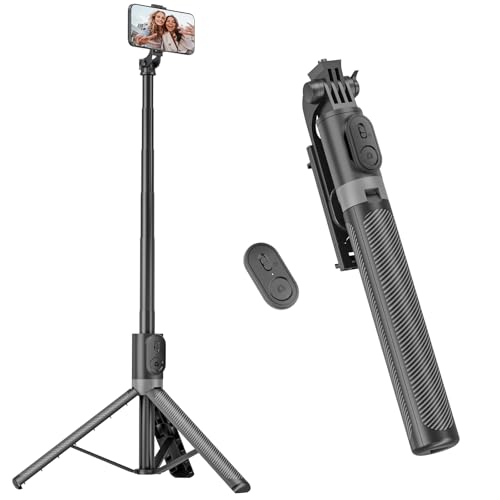
RISEOFLE 71” Phone Tripod & Selfie Stick, Portable All in One Extendable Cell Phone Tripod Stand, with Wireless Remote Control for iPhone/Samsung/Android/Camera
As an Amazon Associate we earn from qualifying purchases. Product prices and availability are accurate as of the date/time indicated.

EUCOS 62" Phone Tripod, Tripod for iPhone & Selfie Stick with Remote | Extendable Cell Phone Stand & Ultimate Phone Holder, Solidest Phone Stand Compatible with iPhone/Android
As an Amazon Associate we earn from qualifying purchases. Product prices and availability are accurate as of the date/time indicated.

Amazon Basics 50-inch Lightweight Portable Camera Tripod Stand with Quick-Release Plate, Adjustable Height, Aluminum, for Travel Photography, Champagne
As an Amazon Associate we earn from qualifying purchases. Product prices and availability are accurate as of the date/time indicated.
Top Tripods for Office Travel Photography Reviewed
Peak Design Travel Tripod, Aluminum
The Peak Design Travel Tripod, Aluminum is a tripod with a max height of 60 inches, a folded length of 15.5 inches, a load capacity of 20 pounds, and a price of $350 to $380. It has a compact design, a fast setup, and a good value. It is a good choice if you want the best tripod vs monopod for office travel photography with a proven Peak Design tripod.
Manfrotto Befree Advanced Tripod
The Manfrotto Befree Advanced Tripod is a tripod with a max height of 59 inches, a folded length of 16 inches, a load capacity of 17.6 pounds, and a price of $180 to $200. It has a compact design, a good value, and a durable build. It is a good choice if you want a Manfrotto tripod with a compact design.
Joby GorillaPod 5K Kit
The Joby GorillaPod 5K Kit is a flexible tripod with a max height of 15 inches, a folded length of 12 inches, a load capacity of 11 pounds, and a price of $150 to $170. It has a flexible design, a compact size, and a good value. It is a good choice if you want a Joby tripod that can wrap around a pole or a railing.
Sirui T-024SK Travel Tripod
The Sirui T-024SK Travel Tripod is a tripod with a max height of 57 inches, a folded length of 13 inches, a load capacity of 26 pounds, and a price of $200 to $230. It has a compact design, a high load capacity, and a good value. It is a good choice if you want a Sirui tripod with a high load capacity.
Top Monopods for Office Travel Photography Reviewed
Manfrotto XPRO Monopod+, Aluminum
The Manfrotto XPRO Monopod+, Aluminum is a monopod with a max height of 66 inches, a folded length of 26 inches, a load capacity of 22 pounds, and a price of $100 to $120. It has a fluid base, a good value, and a durable design. It is a good choice if you want a Manfrotto monopod with a fluid base for video.
Benro MSD46C SupaDupa Monopod
The Benro MSD46C SupaDupa Monopod is a monopod with a max height of 65 inches, a folded length of 23 inches, a load capacity of 44 pounds, and a price of $130 to $150. It has a high load capacity, a compact design, and a good value. It is a good choice if you want a Benro monopod with a high load capacity.
Buying Guide: How to Choose the Best Tripod vs Monopod for Office Travel Photography
Start with your camera, your travel, and your photos. If you use a mirrorless camera with a 24-70mm lens, a compact travel tripod, such as the Manfrotto Befree, is a good choice, because it is stable and light. If you use a DSLR with a 70-200mm lens, a monopod, such as the Manfrotto XPRO, is better, because it supports a heavy lens without a tripod. If you travel by plane, a tripod with a folded length under 18 inches is a good choice, because it fits in a carry-on.
Next, think about the photos you take. For landscapes, architecture, and low light, a tripod is usually better, because it gives you stability for long exposures. For events, sports, and fast-moving subjects, a monopod is usually better, because it lets you move quickly. For video, a tripod with a fluid head is better for smooth pans, while a monopod with a fluid base is better for moving shots.
Consider weight and setup time. If you carry your support all day, weight matters. A monopod at 1.5 pounds is lighter than a tripod at 3.4 pounds. If you need to set up quickly, a monopod is faster, because it has one leg. If you need maximum stability, a tripod is better, even if it is heavier and slower to set up.
Check your budget and your future. Tripods and monopods for office travel photography typically cost $100 to $380. A monopod from $100 to $150, such as the Manfrotto XPRO or Benro MSD46C, offers a good way to start. A tripod from $150 to $230, such as the Joby GorillaPod 5K or Sirui T-024SK, offers a better stability. A tripod from $350 to $380, such as the Peak Design Travel Tripod, offers a premium compact design.
Finally, do not choose based only on price or weight. A tripod that is too light may be unstable in wind, while a monopod that is too short may be uncomfortable. Choose a support that fits your camera, with a load capacity that is at least double your camera weight, and with a height that lets you shoot at eye level. Test your support at home before your trip, and check the rules for tripods in offices and museums.
When a Hybrid Setup Is the Best Choice for Office Travel Photography
A hybrid setup is often the best choice for office travel photography because it gives you both options. Use a compact tripod for planned shots, such as landscapes and group photos, and use a monopod for fast shots, such as events and sports. You can also use a tripod with a removable leg that becomes a monopod, such as the Sirui T-024SK, which has a leg that detaches to become a monopod. That gives you both options in one product.
A hybrid setup does not need to be expensive. A Joby GorillaPod 5K at $150 to $170 plus a Manfrotto XPRO monopod at $100 to $120 gives you both options for about $250 to $290 in total, which is less than a premium travel tripod alone. If you already own a tripod, adding a monopod is a low-cost upgrade. If you already own a monopod, adding a compact tripod is a low-cost way to add stability for low light.
Frequently Asked Questions
Is a tripod or monopod better for travel photography?
Is a tripod or monopod better for travel photography, it depends on your photos and travel. A tripod is better if you take landscapes, architecture, and low-light photos, because it gives you stability for long exposures. A monopod is better if you travel light, move quickly, and take events or sports photos, because it is lighter and faster to set up. For most office travel photography, a compact tripod is the safer first choice, and a monopod is a good second option.
Can I use a monopod for long exposure photography?
Can you use a monopod for long exposure photography, you can use a monopod for a short long exposure, such as 1/4 second, but it will not be as stable as a tripod for a 1-second or longer exposure. A monopod helps reduce shake, but it does not eliminate it, because it has only one leg. For long exposures, use a tripod, with a remote shutter or timer, and a low ISO. For a monopod, use a faster shutter speed, and brace your monopod against your body.
What is the best travel tripod for office travel?
What is the best travel tripod for office travel depends on your camera and budget. A tripod with a folded length under 18 inches, a max height of 59 inches, and a load capacity of 17.6 pounds, such as the Manfrotto Befree Advanced at $180 to $200, is a good choice for most travelers, because it is compact and stable. A tripod with a higher price, such as the Peak Design Travel Tripod at $350 to $380, is also good, especially if you want a premium compact design. Choose a tripod that fits your carry-on and your camera.
Do I need a tripod if I have image stabilization?
Do you need a tripod if you have image stabilization, it depends on your photos. Image stabilization helps with handheld photos, but it does not replace a tripod for long exposures, time-lapses, or video. A tripod is still useful if you take photos in low light, with a slow shutter speed, or with a timer. A monopod is a good compromise if you have image stabilization and want support without a tripod. Choose a tripod for low light, and a monopod for fast, handheld support.
Related guides
- Best Webcam for Dark Office Rooms in 2026: 7 Best Webcams for Dark Office Rooms With Clear Video, Simple Use, and Easy Use for Webcam for Dark Office Rooms
- Best Scanner for Office Small Offices in 2026: 7 Best Scanners for Office Small Offices With Clear Scan, Simple Use, and Easy Use for Scanner for Office Small Offices
- Best High End Monitor for Photo Editing in 2026: 7 Best High End Monitors for Photo Editing With Clear Colour, Simple Use, and Easy Use for High End Monitor for Photo Editing
- Best Budget Tablet for Work Under 100 in 2026: 7 Best Budget Tablets for Work Under 100 With Clear Work, Simple Use, and Easy Use for Budget Tablet for Work Under 100
More from Amazon
Programs that pair well with the guide above. Offers and eligibility are set by Amazon and may change.
Free shipping on eligible items, Prime Video and more. Eligible new members can start with a free trial.
Start a Prime free trialAd-free music streaming. Eligible new subscribers can start with a free trial.
Try Music Unlimited freeA Prime membership for ages 18-24 with a trial period. Eligibility is set by Amazon.
See Prime for Young AdultsAudiobooks and podcasts to listen to on the go. Eligible new members can start with a free trial.
Try Audible freeAs an Amazon Associate we earn from qualifying purchases.

Write Your Review
No reviews yet. Be the first to share your experience!